What If It Doesn’t Work? Throw the Egg Anyway
The Virtual Vibe: Success and Sanity for the Online Teacher
August 31, 2026
Early in my teaching career, I was determined to make science fun. I was teaching eighth graders, which meant I was working with an audience that did not always arrive each morning bursting with enthusiasm about Newton's Laws of Motion. So when it came time to teach Newton's First Law, I had an idea.
I was going to throw eggs at the whiteboard.
In my head, this was brilliant. We would talk about inertia. The egg would be moving forward, the wall would stop it, and science would come alive right there in front of them. Except I had failed to consider one small detail: the amount of force that would be placed on the egg when it hit the wall.
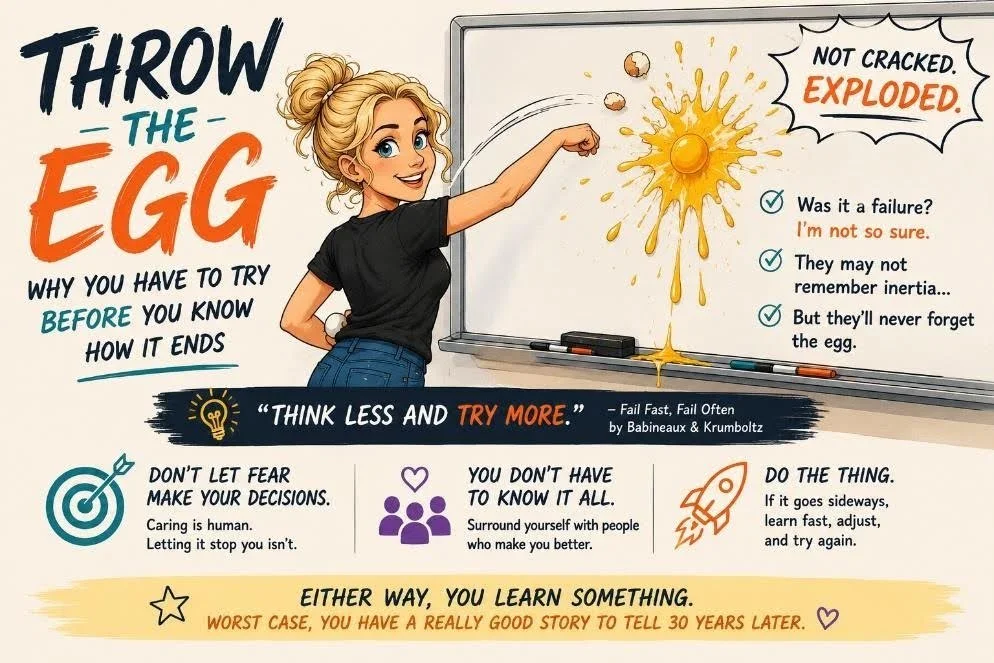
I threw the first egg. It hit the whiteboard and exploded.
Not cracked. Exploded.
Raw egg went everywhere, including all over several students sitting in the front row. Suddenly, nobody cared about Newton. Students were panicking about getting sick from raw eggs, I was trying to clean up what looked like an educational crime scene, and whatever beautiful connection I thought we were going to make to Newton's First Law was officially gone.
Was the lesson a failure? I'm not entirely sure.
Did they learn exactly what I intended for them to learn that day? Debatable. Do I believe there are grown adults walking around today who still remember the time their eighth-grade science teacher launched an egg at a whiteboard and covered their classmates in yolk?
Absolutely.
Maybe they don't remember inertia, but they remember the egg. And honestly, I'll take partial credit.
Then the bell rang, and I had six more classes to teach that day.
There wasn't time to overthink what had gone wrong. I had another group of eighth graders coming through the door, and unless I wanted to coat another row of children in yolk, I needed to figure it out, adjust, and try again.
I didn't know it at the time, but that exploding egg taught me something that has followed me throughout my career: You have to be willing to try before you know how the story ends.
Years later, I came across Ryan Babineaux and John Krumboltz's book Fail Fast, Fail Often. One of the ideas they explore is beautifully simple: think less and try more.
That sticks with me because so much of what keeps us from trying isn't an actual obstacle. It's everything we imagine might happen. We wonder whether we're ready, what could go wrong, and what other people might think if it doesn't work. We can spend so much time trying to predict the outcome that we never give ourselves the chance to discover it.
Back then, my risk was an egg. As I've gotten older, the proverbial eggs have gotten bigger.
Trying something new might mean sharing an idea that could be rejected, taking on a new project, presenting in front of people I respect, or stepping into a leadership opportunity bigger than anything I've taken on before. The stakes have changed, but that little voice asking, What if this doesn't work?” hasn’t disappeared.
I still wonder sometimes if I'm ready. I still worry about getting things wrong. And I absolutely still care what people think.
I don't buy the idea that confidence eventually means you stop caring about other people's opinions. We're human. Of course we care. We want to be respected. We want our ideas to work. We want people to believe we're capable.
The goal isn't to stop caring what people think.
It's time to stop letting what they might think make your decisions for you.
I've also learned that you don't have to know everything before you say yes. Being qualified for an opportunity doesn't mean already knowing everything the opportunity is going to teach you. Surround yourself with people whose strengths complement your own. Ask questions. Learn. Let other people be better than you at things, and bring what you're good at to the table.
There will always be a reason not to do the thing. You're not ready. You don't know enough. Someone else could do it better. People might think it's ridiculous.
Maybe it won't work.
But what if it does?
You'll never know if your need to know the outcome keeps you from ever beginning.
So do the thing. Apply. Say yes. Raise your hand. Share the idea. Try something that might not work.
If it goes sideways, learn fast. Adjust. Try again.
Something not turning out the way you pictured it doesn't automatically make it a failure. Sometimes it's simply information you didn't have before.
Sometimes you throw the egg and discover an incredible new way to teach Newton's First Law. Sometimes you throw the egg and cover a row of eighth graders in yolk.
Either way, you learn something.
Worst case, you have a really good story to tell 30 years later.
Pause, Ponder, and Progress
Pause: What is something you've been avoiding because you're afraid you might fail, look foolish, or discover you're not ready?
Ponder: Whose opinion are you allowing to have more influence over that decision than it deserves?
Progress: What's one small step you can take toward doing the thing before you know exactly how it will turn out?
You don't need to be fearless.
You just need to be willing to throw the egg.
About the Author
With over 20 years in education - most of them spent in the virtual trenches - Desire’ Mosser has done more than survive online teaching; she’s helped others thrive in it! As the author of SOS: Strategies for Online Survival, she dishes out practical tools, honest lessons, and just the right amount of humor to keep educators going.
Former Pasco eSchool Teacher of the Year and Florida Virtual Schools Mentor of the Year, she continues to champion excellence in virtual learning today. She currently serves as President of B.O.L.D. (Blended Online Learning Discovery of Florida). Her passion? Coaching educators to find their stride, build meaningful connections with students and families, and master the art of scheduling for sanity—preferably with a strong cup of coffee in hand. For more real talk, useful tips, and the occasional caffeine-fueled confession, connect with her on LinkedIn.