The AI Question Nobody Wants to Ask
If AI Saves Teachers Time, Who Gets That Time Back?
The Virtual Vibe: Success and Sanity for the Online Teacher
July 27, 2026
Artificial intelligence has quickly become one of the most discussed topics in education. Nearly every conference, webinar, article, and professional learning session includes some discussion about how AI can help educators work more efficiently. The promise is compelling. AI can help draft communications, generate lesson ideas, create differentiated resources, analyze data, and automate repetitive tasks. In many cases, it can accomplish in minutes what once took teachers significantly longer.
As I listen to these conversations, I find myself returning to a different question. It is not whether AI can save teachers time. In many ways, it already has. Instead, I find myself wondering what happens to that time once it has been saved.
If AI gives teachers five hours back each week, who gets those five hours?
The teacher?
Or the system?
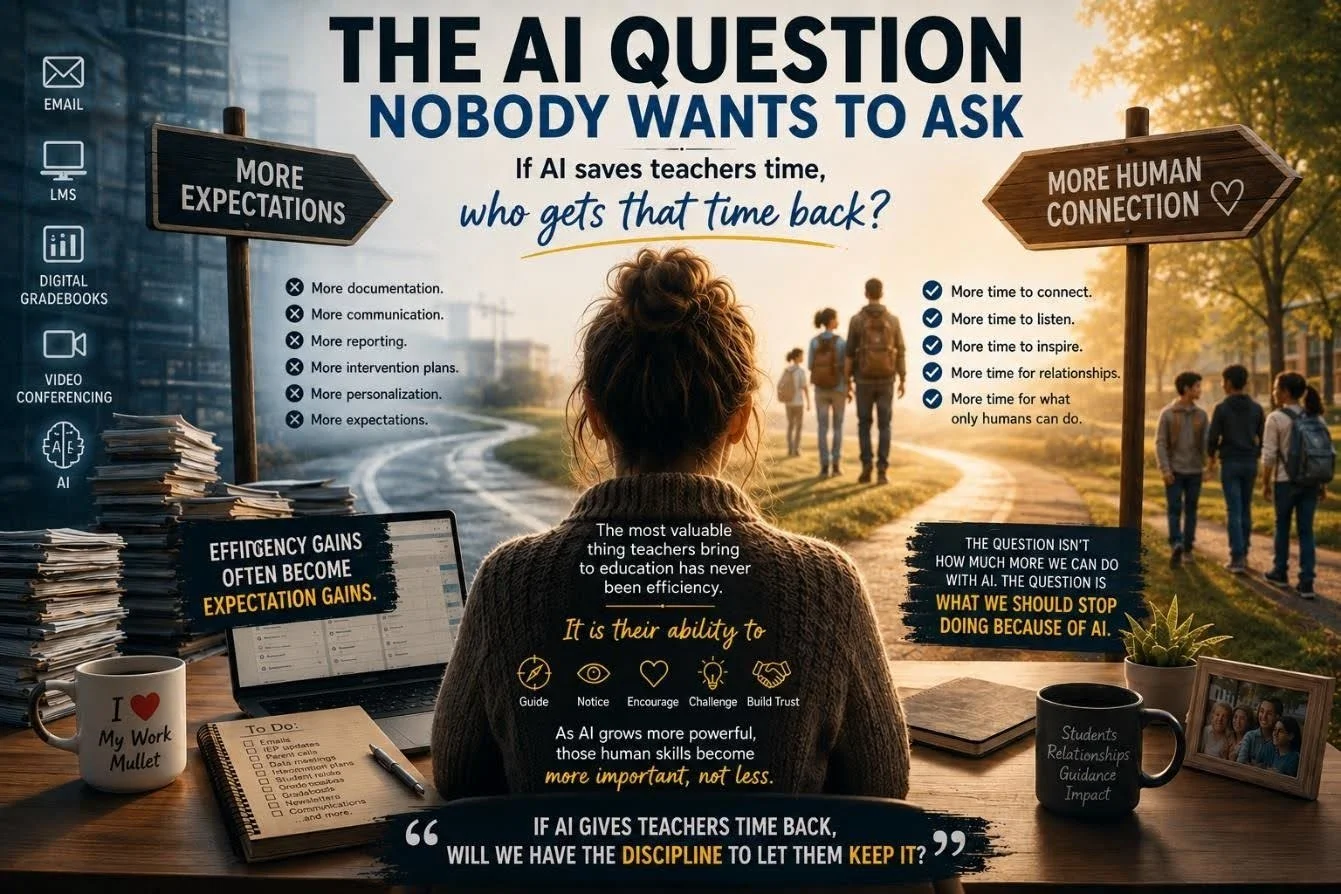
For decades, educational technology has arrived with a remarkably consistent promise: it will save teachers time. Email was supposed to save time. Learning management systems were supposed to save time. Digital gradebooks were supposed to save time. Video conferencing was supposed to save time. Today, AI has joined that list.
Yet teacher workload continues to rank among the leading contributors to burnout and attrition. Educators continue to report feeling overwhelmed by competing responsibilities, increasing expectations, and limited time. That raises an uncomfortable question: If technology keeps saving time, where does the time go?
Perhaps the problem is not that technology has failed to deliver on its promise. Perhaps technology has been successful. Perhaps the real challenge is that every time we create efficiency, we immediately spend it.
Consider a simple example. A teacher who once spent thirty minutes drafting a parent communication may now be able to create a thoughtful first draft in just a few minutes using AI. The technology has unquestionably created efficiency. The question is what happens next. Do those saved minutes create more opportunities to connect with students, provide feedback, or build relationships? Or do they simply become available space that is quickly filled with additional tasks, expectations, and responsibilities?
This distinction matters because efficiency and capacity are not the same thing.
Too often, educational systems celebrate efficiency while failing to protect the capacity that efficiency creates. When a process becomes faster, the temptation is to increase output. More documentation. More communication. More reporting. More intervention plans. More personalization. More expectations.
Over time, efficiency gains can quietly become expectation gains.
As a result, technology may successfully reduce the time required to complete individual tasks while doing very little to reduce the overall burden educators carry.
I worry that we may be asking the wrong question. Instead of asking how much more teachers can do with AI, perhaps we should be asking what teachers should stop doing because of AI.
The distinction is significant.
The most valuable thing teachers bring to education has never been efficiency. It is their ability to guide students through uncertainty, recognize when confidence is fading, encourage persistence when effort feels difficult, challenge thinking, build trust, and help students see possibilities they cannot yet see for themselves. These are deeply human responsibilities. They are also the responsibilities that often have the greatest impact on student success.
As AI becomes more powerful, those human skills become more important, not less.
This is why I believe the conversation about AI should ultimately be a conversation about leadership. The real question is not whether AI can make teachers more productive. The real question is whether we will use that productivity to create more work or more capacity. One path leads to increased expectations. The other creates space for the human work that only educators can do.
The future of AI in education will not be determined by the technology itself. It will be determined by the decisions leaders make about how that technology is used. If every efficiency gain automatically becomes a new expectation, we may find ourselves with more productive systems but no more sustainable ones.
As educational leaders, coaches, and decision-makers, we have an opportunity to think differently. We can view AI as a tool for increasing output, or we can view it as a tool for protecting what matters most: relationships, guidance, connection, and the human side of teaching.
That may be one of the most important leadership decisions we face in the coming decade.
Because the question is not whether AI can save teachers time.
The question is whether we will have the discipline to let them keep it.
Pause, Ponder, and Progress
Pause: Where is AI currently creating efficiency in your organization?
Ponder: When efficiency increases, do expectations automatically increase as well?
Progress: Identify one task technology should replace and one human interaction it should protect.
One Question to Carry Forward:
If AI gives teachers time back, will we have the discipline to let them keep it?
About the Author
With over 20 years in education - most of them spent in the virtual trenches - Desire’ Mosser has done more than survive online teaching; she’s helped others thrive in it! As the author of SOS: Strategies for Online Survival, she dishes out practical tools, honest lessons, and just the right amount of humor to keep educators going.
Former Pasco eSchool Teacher of the Year and Florida Virtual Schools Mentor of the Year, she continues to champion excellence in virtual learning today. She currently serves as President of B.O.L.D. (Blended Online Learning Discovery of Florida). Her passion? Coaching educators to find their stride, build meaningful connections with students and families, and master the art of scheduling for sanity—preferably with a strong cup of coffee in hand. For more real talk, useful tips, and the occasional caffeine-fueled confession, connect with her on LinkedIn.