Fixing Is My Love Language. Unfortunately.
If You Keep Fixing Everything, Everyone Else Stops Learning.
The Virtual Vibe: Success and Sanity for the Online Teacher
July 13, 2026
Have you ever heard someone describe a problem and immediately you started creating a mental five-step action plan before they finished talking?
Same.
Somewhere between teaching, coaching, leadership, and simply caring about people, I developed a reflex that says, “I can help with that.” The problem is that sometimes helping isn’t actually helping.
Over the years, I’ve learned that not every difficult conversation needs to be fixed. Not every frustrated person needs advice. And not every problem needs another person jumping into the middle of it waving a cape and trying to save the day. Sometimes people need a listener. Sometimes they need a thought partner. Sometimes they need a leader. And sometimes they need the opportunity to work through a challenge without someone else stepping in and taking ownership of it.
That’s where many of us get into trouble.
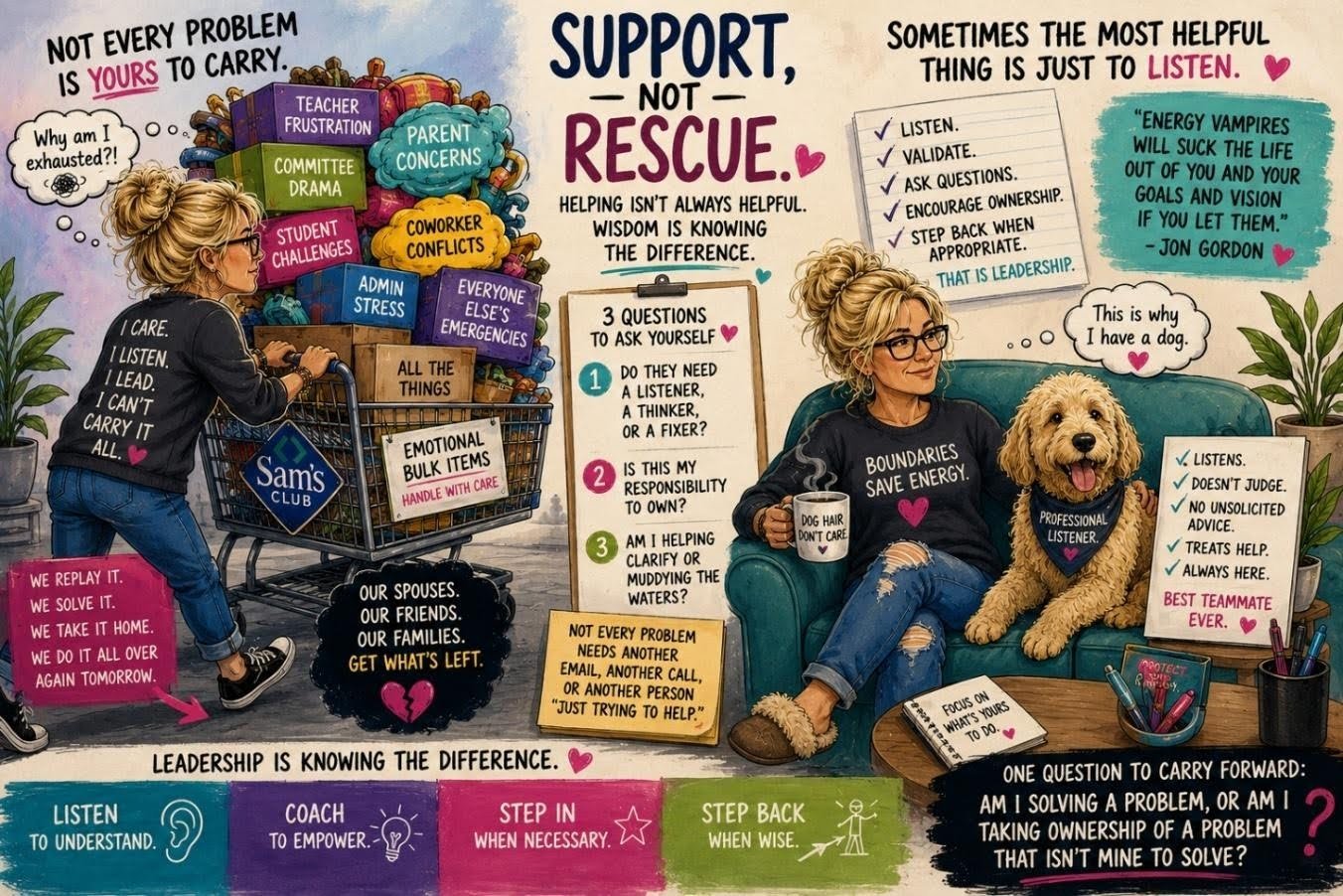
As educators and leaders, we are wired to help. We care deeply about people, outcomes, and relationships. But caring can quietly turn into carrying. We start collecting problems. Teacher frustration? Throw it in the cart. Parent concerns? Add those too. Committee disagreements? Why not? Before long, we are pushing a Sam’s Club-sized flatbed full of emotional bulk items through the checkout line wondering why we are exhausted.
The reality is that many of us do not just listen to problems. We adopt them. We replay conversations. We mentally draft emails. We solve problems while driving. We solve them again in the shower. Meanwhile, our spouses, friends, and families get whatever energy we have left after spending the day carrying things that were never ours to carry in the first place.
This is precisely why I have a dog.
He listens without interruption. He never offers unsolicited advice. He does not tell me what I should have said in the meeting. He simply nods, accepts the occasional treat, and appears genuinely interested in every problem I bring to the table. Whether he actually cares is still under investigation, but his listening skills are unmatched.
The challenge for leaders is not deciding whether to care. It is deciding what to do with what we hear. When someone brings us a problem, it helps to pause and ask three questions.
First, do they need a listener, a thinker, or a fixer? Sometimes people simply need space to process. Sometimes they need questions that help them find their own answers. Sometimes they need intervention. The mistake is assuming everyone needs the fixer.
Second, is this my responsibility to own? This one can be uncomfortable. Every time we solve a problem that rightfully belongs to someone else, we remove an opportunity for them to develop the skills and confidence needed to solve it themselves. Helping someone carry a burden for a moment is leadership. Carrying it for them indefinitely is something else entirely.
Third, am I helping clarify or muddying the waters? This may be the trap I see most often. Someone shares a concern. We send an email. We make a phone call. We pull in another person. We try to smooth things over. We “just want to help.” Suddenly, nobody knows who owns the issue anymore.
Not every problem needs another email chain, another committee member, or another person stepping in to save the day. Sometimes the most helpful thing we can do is encourage the right people to have the right conversation with each other.
As Jon Gordon reminds us, “Energy vampires will suck the life out of you and your goals and vision if you let them.” Most people hear that quote and think about difficult coworkers. I’ve come to realize that constantly rescuing, fixing, and absorbing everyone else’s problems can drain our energy just as quickly.
Leadership is not about carrying every problem you encounter. It is about helping the right people carry the right problems. Sometimes that means listening. Sometimes that means coaching. Sometimes that means stepping in. And sometimes that means stepping back.
The wisdom is knowing the difference.
Pause, Ponder, and Progress
Pause: What problem are you currently carrying that may belong to someone else?
Ponder: Are you helping someone grow, or are you rescuing them from growth?
Progress: This week, before offering a solution, ask one additional question.
One Question to Carry Forward:
Am I responding to facts, or am I responding to a story I've created?
About the Author
With over 20 years in education - most of them spent in the virtual trenches - Desire’ Mosser has done more than survive online teaching; she’s helped others thrive in it! As the author of SOS: Strategies for Online Survival, she dishes out practical tools, honest lessons, and just the right amount of humor to keep educators going.
Former Pasco eSchool Teacher of the Year and Florida Virtual Schools Mentor of the Year, she continues to champion excellence in virtual learning today. She currently serves as President of B.O.L.D. (Blended Online Learning Discovery of Florida). Her passion? Coaching educators to find their stride, build meaningful connections with students and families, and master the art of scheduling for sanity—preferably with a strong cup of coffee in hand. For more real talk, useful tips, and the occasional caffeine-fueled confession, connect with her on LinkedIn.