Grace for Me, Judgment for Thee: Why Curiosity Is More Productive Than Assumption
The Virtual Vibe: Success and Sanity for the Online Teacher
July 6, 2026
A while back, I sent an email to a colleague and didn't receive a response within 24 hours.
Logically, I knew people were busy. They have meetings, deadlines, families, and lives outside of responding to my emails.
Unfortunately, logic had left the four walls of my quant, cat photo filled, living room office.
Instead, I found myself rereading the email looking for a phrase that could have been misunderstood. I considered sending a follow-up email to explain what I meant in the first email. At one point, I was mentally preparing for a difficult conversation that hadn't happened and browsing LinkedIn, convinced I might need to update my resume because clearly this person was trying to determine the nicest way possible to tell me I was being let go.
If you've ever experienced anxiety, you know how quickly a delayed response can turn into a full-blown documentary complete with a script, soundtrack, and worst-case scenario ending.
The interesting part?
None of it was true.
The person wasn't upset. They weren't offended. They weren't planning my professional demise. They were dealing with a family emergency, and my email wasn't even on their radar.
That experience got me thinking about how often we do this in our professional lives.
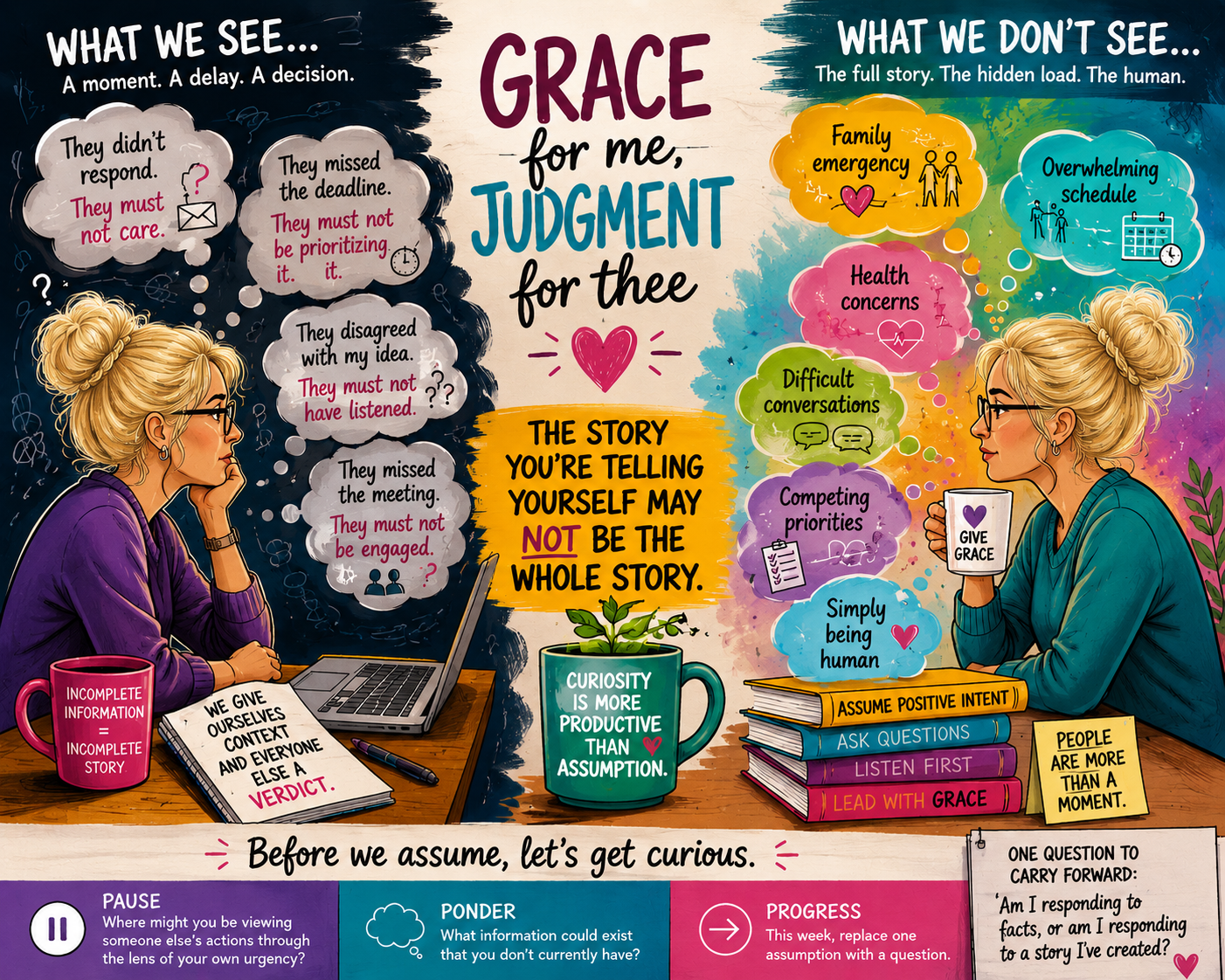
A colleague doesn't respond to an email.
They must be ignoring us.
A decision doesn't go our way.
They must not have listened.
Someone misses a deadline.
They must not be prioritizing their work.
What's interesting is that we rarely extend the same logic to ourselves.
When we miss a deadline, we're overwhelmed.
When we don't respond, we're busy.
When we make a mistake, we're human.
We give ourselves context and everyone else a verdict.
As leaders, teachers, coaches, and team members, that should give us pause.
The assumptions we make about others don't just shape our opinions; they shape our culture. Teams built on trust and positive intent operate differently than teams built on suspicion and frustration.
Giving grace doesn't lower the bar. It simply allows room for people to be human while they work to reach it.
We can hold people accountable and still assume positive intent.
We can have high standards and still be patient.
And perhaps most importantly, we can recognize that it is surprisingly easy to evaluate others through the lens of our own urgency.
The reality is that we are not the only item on someone else's to-do list. We are not the only email in their inbox. We are not the only challenge they are trying to solve.
As educators, we see this play out with students all the time.
A missed appointment becomes, "They don't care."
An unanswered phone call becomes, "The family isn't engaged."
A missing assignment becomes, "They're not trying."
Yet time and time again, we learn there is more to the story than we can see.
Before we assume the worst, maybe we should get curious.
Before we create a story, maybe we should ask a question.
Curiosity is almost always more productive than assumption.
The next time you find yourself filling in the blanks, remember:
The story you're telling yourself may not be the whole story.
Pause, Ponder, and Progress
Pause: Where might you be viewing someone else's actions through the lens of your own urgency?
Ponder: What information could exist that you don't currently have?
Progress: This week, replace one assumption with a question.
One Question to Carry Forward
Am I responding to facts, or am I responding to a story I've created?
About the Author
With over 20 years in education - most of them spent in the virtual trenches - Desire’ Mosser has done more than survive online teaching; she’s helped others thrive in it! As the author of SOS: Strategies for Online Survival, she dishes out practical tools, honest lessons, and just the right amount of humor to keep educators going.
Former Pasco eSchool Teacher of the Year and Florida Virtual Schools Mentor of the Year, she continues to champion excellence in virtual learning today. She currently serves as President of B.O.L.D. (Blended Online Learning Discovery of Florida). Her passion? Coaching educators to find their stride, build meaningful connections with students and families, and master the art of scheduling for sanity—preferably with a strong cup of coffee in hand. For more real talk, useful tips, and the occasional caffeine-fueled confession, connect with her on LinkedIn.